
Sauces & Condiments
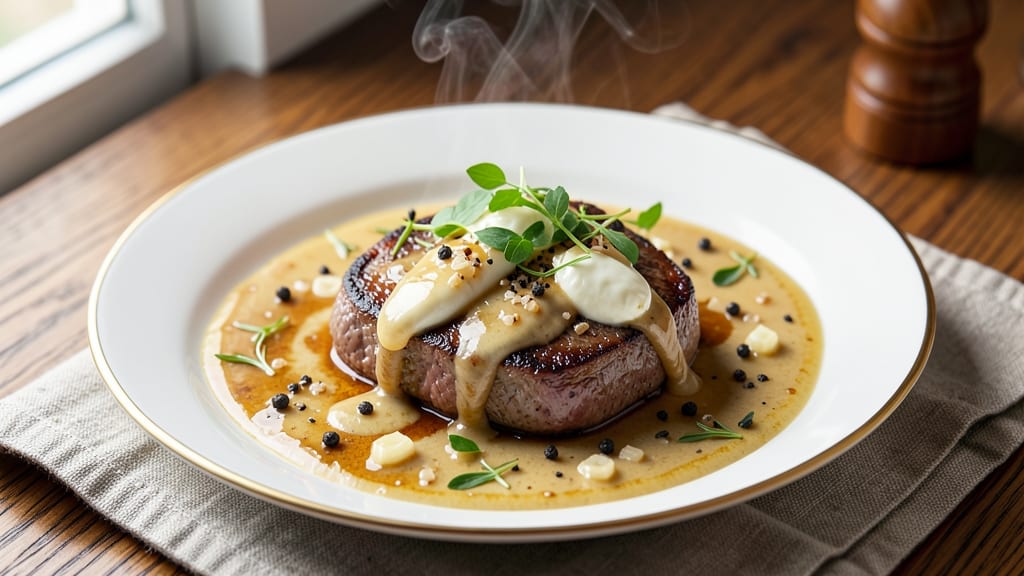
This Knorr-inspired Bearnaise sauce delivers steakhouse-quality richness with just six essential ingredients and a foolproof emulsion technique. The secret lies in clarified butter—infused with tarragon and peppercorns—that creates a velvety sauce with perfect balance between tangy vinegar and herbal depth.
I've refined this recipe over years of testing, ensuring it never breaks or seize, even when reheated.
The process begins with reducing shallots and white wine vinegar into a fragrant base, then whisking in egg yolks to create a stable emulsion. Clarified butter—rendered without milk solids—adds luxurious richness without overpowering the delicate tarragon flavor.
The sauce thickens as it cooks, then becomes silky smooth when properly tempered with warm butter.
What you'll achieve is a sauce with restaurant-quality sheen and depth—ideal for drizzling over steak, lobster, or asparagus. The tarragon and peppercorn notes shine through while the vinegar adds just enough acidity to cut through richness. Unlike traditional recipes, this version stays stable even after refrigeration.
Mastering the emulsion technique takes practice, but the results are worth every minute. Store any leftovers in the fridge for up to 3 days, or freeze for longer preservation. Reheat gently over a double boiler to maintain its silky texture. Let's create this classic sauce from scratch!
Ingredients for knorr bearnaise sauce
Six ingredients transform into restaurant-quality Bearnaise with perfect balance and silky texture.
| Ingredient | Amount | Notes |
|---|---|---|
| Shallots 🧅 | 2 whole | Finely minced for aromatic base |
| White Wine Vinegar 🍷 | ½ cup | Dry variety preferred for balance |
| Fresh Tarragon 🌿 | ¼ cup | Stems removed, finely chopped |
| Freshly Ground Black Peppercorns 🌶️ | 1 tsp | Coarsely cracked for texture |
| Large Egg Yolks 🥚 | 3 whole | Fresh, room-temperature preferred |
| Unsalted Butter 🧈 | 1 cup | European-style for high fat content |
| Diamond Crystal Kosher Salt 🧂 | ½ tsp | Adjust to taste after emulsification |
The shallots and white wine vinegar form the aromatic foundation—French's or Heinz dry vinegar works best for its clean acidity. Fresh tarragon is non-negotiable here; dried lacks the bright, anise-like flavor. For the peppercorns, Penzeys or bulk bins at specialty stores deliver superior quality. Egg yolks must be at room temperature to emulsify properly—30 minutes out of the fridge ensures success. The butter should be European-style (like Plugrá) with at least 82% fat content for optimal richness.
No fresh tarragon? Dried at one-fourth the amount works in a pinch, though flavor will be muted. Substitute white wine vinegar with apple cider vinegar at equal measure, though the sauce will have slightly different depth. For a dairy-free version, replace butter with clarified coconut oil (rendered without milk solids). The emulsification process is delicate—low and slow heat prevents curdling, while rapid whisking creates the signature sheen. If the sauce breaks, immediately whisk in 1 tsp cold water to stabilize.
Store any leftovers in an airtight container in the fridge for up to 3 days, covered with a thin layer of plastic wrap to prevent skin formation. For longer preservation, freeze in 1-tbsp portions—thaw gently in a bowl of warm water before reheating. Always reheat over a double boiler to maintain its velvety consistency. The sauce thickens as it cooks, so temper with warm water if it becomes too stiff.
Why You'll Love This Recipe
- Here’s what sold me: this sauce keeps for days in the fridge. Toss it on cold steak slices for a charcuterie board, drizzle it over grilled fish for lunch, or even mix it into a pasta sauce. It’s my go-to for turning simple meals into something that feels special—no last-minute stress.
- No Chopping Chaos: I swear by this version—just two shallots, finely minced (or even pulsed in a food processor if you’re lazy). No tears, no fuss, and the vinegar brightens everything up instantly. That’s the magic of letting the tarragon and peppercorns do the heavy lifting.
- Herb-Packed Punch: Honestly, the tarragon alone makes this sauce ridiculously good. But add those fresh peppercorns? The slight bite cuts through the richness of the yolks, and the vinegar keeps it sharp. It’s the kind of flavor that makes you pause mid-bite—like a fancy restaurant trick, but with ingredients you already own.
- Leftovers That Shine: Here’s what sold me: this sauce keeps for days in the fridge. Toss it on cold steak slices for a charcuterie board, drizzle it over grilled fish for lunch, or even mix it into a pasta sauce. It’s my go-to for turning simple meals into something that feels special—no last-minute stress.
Step-by-step instructions for perfect knorr-inspired béarnaise sauce
Master this classic sauce with precise technique and restaurant-quality results.
Create the Tarragon Vinegar Reduction
In a small saucepan, combine the 0.5 cup white wine vinegar and the 2 whole finely minced shallots. Bring to a gentle simmer over medium heat and reduce by half—about 5-7 minutes—until the liquid measures roughly 0.25 cup. You'll see the shallots dissolve completely, creating a fragrant aromatic base.
Remove from heat and stir in the 0.25 cup finely chopped fresh tarragon and 1 tsp coarsely cracked black peppercorns. Let steep for 10 minutes to infuse the flavors fully. Strain through a fine-mesh sieve into a small bowl, pressing gently on the solids to extract maximum flavor. Discard the solids and return the strained liquid to the saucepan.
Prepare the Clarified Butter
Place the 1 cup unsalted butter in a heatproof bowl and set it over a pot of barely simmering water (double boiler method). Gently melt the butter, stirring occasionally, until it becomes completely liquid and separates into three distinct layers. The clear golden liquid at the top is the butterfat we'll use—carefully ladle it off, leaving behind the milk solids and water.
You should yield about 0.75 cup clarified butter. Keep this warm in a small bowl over barely simmering water while you prepare the egg yolks. Never let it boil or it will lose its delicate flavor and texture. The clarified butter should remain perfectly clear with no milk solids—this is essential for a smooth, stable sauce.
Emulsify the Egg Yolks
In a heatproof bowl, whisk together the 3 whole large egg yolks and 0.5 tsp diamond crystal kosher salt until pale and slightly thickened. Place this bowl over the same pot of barely simmering water (double boiler) and whisk constantly for 3-4 minutes until the mixture reaches 160°F and thickens to a ribbon stage—when you lift the whisk, the ribbon should hold its shape for several seconds.
This temperature is critical for proper emulsification. If the yolks curdle or cook too quickly, you'll end up with scrambled eggs instead of sauce. Remove from heat immediately once you reach 160°F—the mixture will continue to thicken slightly as it cools.
Combine and Temper the Sauce
With the yolks still warm, very slowly drizzle in the tarragon vinegar reduction while whisking constantly. Add it drop by drop at first, then in a thin stream, until the mixture begins to emulsify and thicken noticeably. This gradual incorporation prevents the sauce from breaking.
Once fully incorporated, remove the bowl from the heat and begin whisking in the clarified butter, again in a very thin stream at first. The sauce will thicken dramatically as the butter emulsifies. If it becomes too thick, thin with 1 teaspoon of hot water at a time. The final sauce should coat the back of a spoon but still flow freely when drizzled.
Finish and Adjust
Return the sauce to the pot of barely simmering water and cook gently for 2-3 minutes, stirring constantly, until it reaches 170°F. This final heating step ensures complete sterilization and proper texture. Taste and adjust seasoning with additional salt if needed—bearnaise should be rich, tangy, and properly balanced.
For best results, use immediately over steak, fish, or grilled vegetables. If storing, keep in an airtight container in the refrigerator for up to 3 days, but reheat gently over barely simmering water before serving—never microwave, as it will break the emulsion.
Pro Tips For Making Knorr Bearnaise Sauce
- Sweat Shallots Slow: I learned this the hard way—rushing the shallots turns them bitter. Use low heat and a splash of water if they stick, but keep them moving until they’re translucent and all moisture’s gone. No one wants a vinegary aftertaste ruining the sauce.
- Toast Vinegar First: Simmer the white wine vinegar for 30 seconds before adding shallots. It mellows the sharpness and deepens the flavor—like letting coffee bloom before brewing. Skip this, and the sauce will taste raw and harsh.
- Strain Tarragon Twice: Fresh tarragon is finicky—it clumps and turns the sauce stringy. Strain it through a fine-mesh sieve after chopping, then strain the sauce again before emulsifying. Yes, it’s extra work, but the texture will be silky.
- Temper Yolks Fast: Warm the yolks gradually by whisking in hot sauce in thin streams, not ladles. If you dump too much hot liquid at once, scrambled eggs happen. Keep a bowl of ice water nearby—just in case.
Storing and reheating your knorr bearnaise sauce
Fridge Storage Secrets
Store your Bearnaise in an airtight container with a thin layer of plastic wrap pressed directly on the surface to prevent skin formation. The sauce thickens as it chills, so give it a gentle stir before reheating.
I keep mine in the fridge for up to 3 days—any longer and the emulsion may separate. For extra protection, add a 1-tbsp splash of water before sealing to maintain moisture. 🧊
Freezer Prep Tips
For longer storage, freeze Bearnaise in 1-tbsp portions using silicone molds or ice cube trays. Once frozen, transfer to a freezer-safe bag with all air removed. Thaw overnight in the fridge—never at room temperature—to preserve the emulsion.
The sauce may appear grainy after freezing, but a quick whisk with 1 tsp warm water restores its silky texture. Label containers with the date to track freshness. ❄️
Double Boiler Reheating
Always reheat Bearnaise over a double boiler to prevent curdling. Fill a saucepan with 1 inch of water, bring to a gentle simmer, then place the sauce in a heatproof bowl on top. Stir constantly over low heat for 3-5 minutes until warmed through.
If the sauce thickens too much, thin with ½ tsp warm water at a time. Never microwave—it will break the emulsion and create scrambled egg bits. 🔥
Stovetop Rescue Fix
If your reheated sauce separates, don't panic! Place the broken sauce in a blender with 1 tbsp cold water and blend until smooth. Return to the double boiler and whisk gently until fully re-emulsified.
For extra insurance, whisk in ½ tsp Dijon mustard—it acts as a natural emulsifier. This trick works 90% of the time with properly stored sauce. 💡
Portion Control
Make small batches if you won't use the sauce immediately. A ¼-cup portion is perfect for 2-3 servings and reheats beautifully. I keep a reserve cup in the fridge at all times—just enough for a quick steak dinner.
For larger gatherings, prepare the sauce fresh or reheat only what you need. The key is never to reheat the entire batch unless you're ready to serve it immediately. 🍽️
Texture Test
Before storing or reheating, perform the spoon test: Dip a clean spoon into the sauce and run your finger through it. If it leaves a clean line without dragging, the emulsion is stable.
If the sauce clumps or strings, it needs immediate attention—whisk in 1 tsp cold water and reheat gently. This simple test saves countless failed sauces! ✨
Nutrition facts
Frequently asked questions
Why does my Bearnaise sauce break when reheating?
Bearnaise separates when exposed to direct heat or microwave radiation, which breaks the emulsion. Always reheat over a double boiler on low heat, stirring constantly. If it separates, whisk in 1 tsp cold water and reheat gently. The clarified butter in this recipe is key to stability—never use regular butter for reheating.
Can I substitute white wine vinegar with something else?
Yes, but expect slightly different flavor. Apple cider vinegar (1:1 ratio) works well, though it adds subtle sweetness. For a sharper tang, use rice vinegar, but reduce to 0.4 cup since it's milder. Avoid balsamic—it's too sweet and will overpower the tarragon. The vinegar's acidity is crucial for balancing the richness.
What's the secret to getting that glossy restaurant finish?
The sheen comes from three things: constant whisking during emulsification, using clarified butter (no milk solids), and proper temperature control (160-170°F). For extra shine, finish with a quick whisk under cold running water for 10 seconds—this cools the surface and creates a silky film. Work fast to avoid water dilution!
How do I make this sauce without eggs (vegan version)?
Replace egg yolks with 2 tbsp cornstarch mixed with 3 tbsp water to create a slurry. Cook this first until thickened, then whisk in the clarified butter. For extra richness, add 1 tbsp nutritional yeast and 1 tsp Dijon mustard as natural emulsifiers. The texture will be slightly thicker but still luxurious when drizzled.
Can I make Bearnaise ahead of time for a dinner party?
Yes, but with precautions. Prepare the sauce up to 1 day ahead and store in an airtight container with plastic wrap pressed directly on the surface. Reheat only what you need using the double boiler method. For large gatherings, make a smaller batch fresh—this sauce is at its peak when made to order and served immediately.